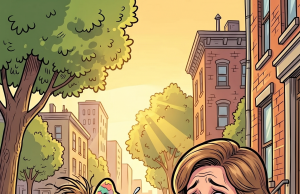
Hello to everyone coming from Facebook. If you’re here, it’s because you were left breathless watching the video of Max barking at that empty wall. I know many of you commented saying it was probably rats or old pipes, and believe me, I thought the same thing. I wish it had been rats. What you’re about to read is the full, uncensored story of what we actually found when we tore down that wall and how our dog tried to save us from a darkness we’d been ignoring for months.
The Behavior That Shattered Our Peace
To understand the horror of that night, you first have to understand who Max is. He’s not a nervous dog. He’s a five-year-old Golden Retriever with the soul of a Tibetan monk. Max is the kind of dog who lets kids pull his ears and sleeps through thunderstorms. So, when his behavior changed drastically three weeks after we moved into the new apartment, we knew—or should have known—that something was terribly wrong.
At first, it was subtle. He stood in the hallway, his body rigid as a statue, staring at a blank spot on the far wall, right between the master bedroom door and the bathroom. He didn’t bark, he just stared. His ears twitched as if he were listening to a conversation that, to us, was nonexistent. My wife, Clara, said he was simply adjusting to the new surroundings, to the noises of the neighbors, to the smells of the city. “It’s just moving stress,” she would repeat to me as she poured her coffee in the morning, trying to convince herself.
But the situation escalated one Tuesday night. I was awakened by a wet, rhythmic sound. When I turned on the hallway light, I found Max licking the wall. He wasn’t sniffing it; he was licking it with frantic anxiety, drooling excessively. When I tried to move him away, he growled at me. It was a low, guttural growl, a sound that had never come from his throat before. His eyes weren’t my dog’s; they were dilated, bloodshot with pure fear.
The following nights became psychological torture. Max started scratching. It wasn’t a normal scratch to ask to be let out; it was a desperate attempt to break through the plaster. His paws began to bleed, leaving red marks on the pristine white paint we had loved so much when we rented the apartment. Clara began to be afraid of being alone at home. “I feel like someone is watching me when I’m in the shower,” she confessed to me one night, her voice trembling. I tried to be the rational one, the pillar of the house. I told her about mice in the attic, termites, any logical explanation that might calm our shattered nerves.
The Decision to Break the Silence
The final straw came yesterday. We were having dinner when Max, who had been dozing under the table, shot out into the hallway. He started barking so violently that the windowpanes rattled. He was barking at wall, as if trying to scare away an invisible intruder. He was throwing himself against the plaster, hitting his shoulder again and again.
Clara started to cry. “Do something, please, make him stop!” she screamed, covering her ears.
It was at that moment that rationality abandoned me. Adrenaline and fear mixed into a dangerous cocktail. I went to the toolbox and took out the heavy hammer. Max, seeing me with the weapon in my hand, stepped back, panting, but still staring at the exact spot: a section of the wall that sounded strangely hollow when I tapped it with my knuckles.
“If there are rats in there, I’m going to get them out right now,” I said, more to convince myself than Clara.
The first blow was timid. The plaster dented. The second was furious. White powder exploded in the air, filling the hallway with a suffocating mist. I pounded on the door again and again, driven by the need to find an answer, to reclaim the peace of my home. When I finally managed to open a hole the size of a soccer ball, I stopped. Max had stopped barking. The silence that followed was sudden and heavy, as if we’d turned off the sound of a horror movie.
The first thing I noticed wasn’t visual, it was olfactory. The hole didn’t smell of dampness, or dead rats, or old pipes.
It smelled sweet. Cloying.
It smelled like cheap perfume mixed with old wax and something metallic. It was a scent that didn’t belong inside a building. It was a human smell.
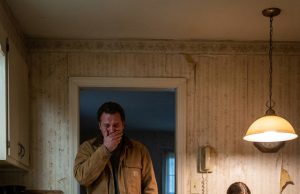
With trembling hands, I turned on my phone’s flashlight and brought my face close to the hole. Clara was behind me, clutching my shirt, breathing in short gasps. The beam of light cut through the darkness of the opening. My eyes took a few seconds to focus, trying to make sense of the shapes I saw between the wooden studs.
When I finally understood what I was seeing, I felt the ground disappear beneath my feet. My stomach lurched violently.
“Oh my God…” Clara whispered before letting out a scream that ripped my eardrums.
They weren’t rats. What Max had been feeling all this time was much worse.
What the Light Revealed
Clara’s scream echoed down the hallway, but I couldn’t move. I was paralyzed, my gaze fixed on the inside of that false wall. There was a space about forty centimeters deep between the wall of our hallway and the building’s original structure, an architectural “false bottom” that someone had meticulously exploited.
In front of me, illuminated by the cold light of my phone, was an altar.
It wasn’t a pile of trash. It was a deliberate, unsettling, and painstakingly crafted structure. On a wooden shelf crudely nailed to the beams, dozens of red and black candles, already burned out, had formed cascades of hardened wax, resembling stalactites of dried blood. And at the heart of this madness reigned the chaos of an obsession.
I grabbed the hammer again and, with a frenzy born of panic, finished breaking the plaster until I had opened a hole large enough to squeeze half my body through. I needed to see it up close. I needed to confirm that I wasn’t hallucinating.
The interior was covered with photographs. Hundreds of them. They were tacked on with rusty thumbtacks, overlapping one another like the scales of a reptile. They were all of the same woman. A young woman, in her early twenties, with her brown hair pulled back in a ponytail and a smile that, in the photos, was gradually fading.
There were photos of her walking down the street, taken from a distance with a telephoto lens. Photos of her buying fruit. Photos of her waiting for the bus. But the ones that made me want to throw up were the others: photos taken from inside this same apartment, but from impossible angles. Photos of her sleeping on the sofa. Photos of her coming out of the shower, blurred by the steam.
“She’s been watching us…” Clara sobbed, leaning over my shoulder. “Are these photos of me? Is that me?”
“No, love, it’s not you,” I said, trying to keep my voice steady even though it was trembling. “It’s the girl who used to live here. It’s Elena.”
I remembered the name because letters had arrived for her at first, letters we returned to the post office. Elena Martínez.
The “Admirer’s” Sanctuary
I started taking the things out carefully, using a rag so as not to touch anything directly, even though I knew my fingerprints would already be everywhere. There was women’s underwear, old and dusty, folded with obsessive neatness. There was a hairbrush with brown strands still tangled in the bristles. A half-used tube of lipstick.
But the most disturbing thing was the letters. Bundles and bundles of letters tied with gift ribbons, stacked like bricks.
I opened one at random. The handwriting was small, cramped, nervous.
“Elena, you wore the blue dress today. I knew you would. It suits you better than the red one; red makes you look vulgar, and you’re a queen. I didn’t like the way you smiled at the cashier at the supermarket. He doesn’t deserve you. No one deserves you, only me, who knows the sound of your breathing when you sleep.”
I felt a chill run down my spine. Max, who had remained silent, watching our desecration, let out a pitiful groan and hid between Clara’s legs. He could feel the lingering energy. He knew that place was charged with a dense, sticky evil.
I kept reading. The letters told a real-time horror story.
“Why did you change the locks, my love? Do you think that will stop me? I have the keys to your soul. Last night I came in while you were dreaming. I stroked your hair and you didn’t wake up. You’re so beautiful when you’re not scared.”
“We have to go,” Clara said, backing away from the front door. “We have to leave this house right now.”
“Wait,” I said, taking the last envelope from the stack. It was different from the others. It wasn’t yellowed with age. The paper felt… fresh.
The date on the envelope hit me like a punch to the gut.
The letter was dated three weeks ago. Three weeks. The same day we moved out.
My hands started sweating as I opened the envelope. The paper rustled in the silence of the apartment. I read the lines and felt the blood drain from my face.
“She’s gone. The ungrateful wretch escaped in the night. But it doesn’t matter. Others have come. Intruders. They’ve taken over our nest, Elena. They sleep in our room. The dog… the damned dog knows I’m here. He growls at me through the wall. But it doesn’t matter. I’ll silence them. Soon I’ll reclaim our home. I’m just waiting for them to fall into a deep sleep once more.”
The letter slipped from my hands. It wasn’t an ancient altar. It wasn’t a relic of the past.
The Night the Nightmare Ended
The chaos that erupted in the next few seconds is something I still see in my nightmares. I screamed. I grabbed Clara’s arm and pushed her toward the exit while Max, forgetting all his fear, lunged toward the opening, barking with murderous fury, ready to kill or die for us.
We stumbled out of the apartment, barefoot, running down the building’s hallway while I frantically called the police. The neighbors came out, alarmed by the commotion, but we didn’t stop until we were on the street, under the safety of the streetlights.
The police arrived in less than five minutes, but for us it felt like an eternity. They came upstairs with their guns drawn. We heard shouts, blows, and then the unmistakable sound of someone being handcuffed.
When they came back down, they were bringing in a man. It was Roberto Vega, the former tenant of 4B, the man who had supposedly moved out six months earlier. He was dirty, emaciated, with a vacant stare and a crooked smile that chilled me to the bone. He glanced at us as he passed, then looked at Max.
“Nice dog,” he muttered. “Too bad he barks so much.”
The investigation revealed the whole truth, a truth more twisted than we had imagined. Roberto had never left the building. He had copies of the keys not only to our apartment, but also to the maintenance rooms and access to the ventilation ducts. He had been living like a ghost in the bowels of the building, going down to our apartment—his “sanctuary”—when we weren’t there, or watching us through the vents.
The altar wasn’t sealed. It had a false panel at the back that connected to the utility room. That’s how he got in. That’s how he fed his obsession.
The Encounter with Elena
Weeks later, the police managed to contact Elena. She was living in another city, hundreds of miles away, trying to rebuild her life. She agreed to speak with us on the phone. Her voice was fragile, broken.
She told us that for months she felt like she was going crazy. That things were moving around, that she heard breathing, that she could smell that cloying perfume—the perfume Roberto had once given her and that she had thrown away. No one believed her. They told her she was stressed, that she was paranoid. She ran away to save her sanity, unaware of how close she had come to losing more than just her mind.
When we told her we had recovered her letters, her photos, and her jewelry, she cried. Not from sadness, but from relief. The validation that she wasn’t crazy was the closure she needed.
“Thank you,” she said between sobs. “And thank you to Max. He did what no human could: see the truth.”
Max’s Lesson
We moved the next day. We couldn’t spend another night in that place, knowing we had slept just meters away from a man who watched us in the dark.
Today, we live in a house with a garden. Max is back to being the calm dog he always was. He no longer stares at the walls. He no longer growls at nothing. But I’ve changed.
Every time I see Max perk up his ears and stare at some empty space, I don’t ignore him. I don’t tell him, “Be quiet, it’s just the wind.” I stop. I observe. And I trust.
We learned the hard way that an animal’s instinct is purer and sharper than any human logic. They see what we refuse to see. They smell danger disguised as normality. Max wasn’t barking at a wall; he was barking at the evil that lived behind it.
If there’s a moral to this story, it’s this: If your dog is afraid of something in your house, don’t assume he’s crazy. Assume he’s seeing something that you, in your innocence, can’t see. And for goodness’ sake, listen to him before it’s too late.