The Resonance of a Midnight Secret
The clock on the mantel had just signaled the half-hour mark after two in the morning when I found myself navigating the darkened corridor of our suburban home. The air was thick with the scent of old wood and the lingering dampness of a relentless October storm that battered the windows in a frantic, rhythmic percussion. I had slipped out of bed to find a glass of water, my footsteps silenced by the plush hallway runner, but as I approached the guest wing where my mother-in-law had taken up residence four months ago, a sound fractured the stillness. It was Julian’s voice—a low, agonizing rasp that carried a tremor of vulnerability I had never encountered in the ten years we had been together.
“I’ve reached my limit, Mom… I truly don’t know how much longer I can maintain this charade without losing my mind.”
The words acted like a physical barrier, freezing me in place just outside the heavy oak door. My chest constricted with a sudden, sharp pressure, and I instinctively pressed my shoulder against the cool plaster of the wall, my breathing becoming a series of shallow, rhythmic gasps. It was a common occurrence for Julian to check on Beatrice in the early hours; she was a woman of fragile constitution, plagued by bouts of vertigo and a persistent, floating anxiety that seemed to demand his presence at all hours. Until this precise second, I had viewed his middle-of-the-night vigils as a testament to his character—a sign of a devoted, compassionate son.
Now, the atmosphere in the hallway shifted, turning cold and predatory. Beatrice’s voice followed, sounding remarkably steady and devoid of the frailty she performed during the daylight hours. “You need to keep your voice down, Julian. You’ll wake her, and then we’ll have a different set of problems to manage.”
A heavy, pressurized silence followed, broken only by the howl of the wind outside. Then Julian spoke again, his words dropping like stones into a deep, dark well. “Perhaps it’s time she finally woke up to the reality of this house.”
The Architecture of Possession
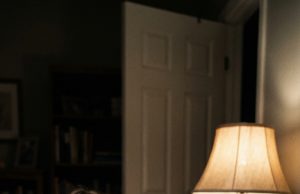
The door was ajar by only a fraction of an inch, a sliver of amber light escaping from the bedside lamp. Driven by a compulsion I couldn’t name, I leaned toward the opening. Julian was perched on the edge of the mattress, his broad shoulders hunched forward as he buried his face in his palms. Beatrice sat beside him, her expression one of serene focus as her fingers moved through his hair in a slow, hypnotic motion that felt disturbingly intimate. It was not the gesture of a mother comforting an adult child; it was the touch of someone tending to a prized possession, an athlete checking the condition of a valuable thoroughbred.
“I’m utterly spent,” Julian whispered, his voice muffled by his hands. “I don’t know how to keep living two separate lives under the same roof.”
Beatrice’s hand paused for a heartbeat, her rings glinting in the dim light, before she resumed the stroking. “You are doing what is necessary, Julian. You are fulfilling your obligation.”
“I’m doing what’s right for you,” he countered, a jagged edge of resentment slicing through his exhaustion.
Beatrice’s tone sharpened, losing its honeyed veneer. “Do not retreat into that particular line of thinking again. We made an arrangement.”
“I have a wife, Mom,” Julian said, his voice finally fracturing under the weight of his grief. “A woman I love. I can’t keep pretending that our life together is just a temporary distraction from the work of being your son.”
I felt the air leave my lungs as the word temporary echoed through my mind, shattering the foundation of every memory I held dear. I retreated into the shadows of the hallway, my heart hammering against my ribs with such violence that I was certain they could hear the thudding through the walls. My mind scrambled to reconcile the man I had married with the person currently being dismantled in the next room.
An arrangement? A charade? Temporary?
The concepts were nonsensical, yet they fit together with a sickening, mathematical precision. I lay back in our bed minutes later, staring at the ceiling and listening to the storm. When Julian finally returned, slipping under the covers with a heavy sigh, I lay perfectly still, pretending to be lost in sleep while I realized that the man breathing beside me had become a total stranger in the span of five minutes.
The Mask of the Morning
When the sun finally struggled through the gray morning mist, the house appeared entirely unchanged. The smell of freshly brewed coffee filled the kitchen, and the television hummed with the morning news, yet the domestic scenery felt like a film set where the actors had forgotten their lines. Julian pressed a lingering kiss to my forehead before reaching for his briefcase, his eyes searching mine with a concerned intensity. “You look exhausted, Elena. Did the thunder keep you awake?”
“I just didn’t sleep well,” I replied, my voice sounding thin and distant even to my own ears.
He offered a sympathetic smile, but it was a practiced thing—a hollow gesture that didn’t travel as far as his eyes. Beatrice was already seated at the breakfast nook, elegantly sipping her herbal tea as if she hadn’t spent the night orchestrating the emotional collapse of her son.
“You look quite pale today, dear,” she said, her voice dripping with a cloying, performative sweetness. “Perhaps you should consider a nap later. The house can be so draining when the weather is this foul.”
Her gaze lingered on mine for a second too long, a silent challenge hidden behind her grandmotherly facade. In that look, I realized she suspected that the walls of her fortress had been breached. Over the next seventy-two hours, the scales fell from my eyes. I began to notice the subtle, systematic ways Julian defered to her. He didn’t just consult her on major financial decisions; he sought her approval for the mundane details of our existence. The menu for our upcoming anniversary dinner, the brand of detergent we used, the very trajectory of our weekends—everything was filtered through the lens of Beatrice’s preference.
If we planned an evening out, her “health” would inevitably decline an hour before our departure. If I discussed the possibility of looking for a house with more land, she would launch into a monologue about her need for “stability” and “closeness” in her final years. Julian chose her every single time, moving through the world like a man tethered to a weight he was too terrified to set down. What I had once characterized as a beautiful, rare bond between mother and son now revealed itself as a suffocating architecture of control.
The Breaking of the Seal
By the third night, the pressure within my chest had reached a boiling point. We were sitting in the living room, the only sound being the crackle of the fireplace, when I finally lowered my book and looked at him. “Julian,” I said, the name sounding heavy in the quiet room, “we need to discuss what is happening in this house.”
He stiffened visibly, his body adopting a defensive posture. “What exactly are you referring to, Elena?”
“I heard the conversation in the guest room on Tuesday night,” I said, refusing to look away. “I heard every word about pretending and arrangements.”
The color drained from his face, leaving him looking sickly in the firelight. “You shouldn’t have been eavesdropping on a private moment, Elena. That was a conversation between a mother and her son.”
“I wasn’t eavesdropping, Julian. I was walking down the hallway of my own home and I heard my husband describe our marriage as a charade,” I replied, my voice trembling with a mixture of rage and profound sadness. “I need you to explain to me what is going on, because I feel like I’m living in a ghost story.”
He stood up and began to pace the length of the rug, his hands shoved deep into his pockets. “It’s not as simple as you think. You couldn’t possibly understand the weight of the history involved here.”
“Then make me understand,” I demanded. “Because right now, I’m looking at a man who is actively choosing a lie over the woman he supposedly loves.”
He stopped by the window, staring out at the darkness. When he finally spoke, his voice was so low it was nearly swallowed by the shadows. “My mother doesn’t believe in the concept of a shared life. She views love as a finite resource, and she spent my entire childhood ensuring that I understood I was her only source of it.”
The Contract of the Son
The story Julian told me was one of psychological warfare. When his father had walked out two decades ago, Beatrice hadn’t just grieved; she had weaponized her sorrow, transforming her young son into a surrogate for everything she had lost. She had cultivated a dependency so total that Julian had grown up believing her very survival depended on his proximity.
“Whenever I tried to build a life of my own, she would manifest physical symptoms that no doctor could explain,” Julian admitted with a hollow, mirthless laugh. “Fainting spells, heart palpitations, agonizing migraines—they were all perfectly timed to ensure I never stayed away for too long. And it worked. It always worked.”
“And when you met me?” I asked, the realization of our history beginning to burn.
“She viewed you as a threat to her survival,” he said, finally turning to face me. “She made me promise, the week before our wedding, that you would never truly come first. She made me swear an oath that her needs would always be the priority of this household.”
“And you agreed to that?” I whispered, the betrayal feeling like a physical blow to my stomach.
“I was terrified of being responsible for her collapse, Elena. I didn’t know how to exist without the weight of her guilt on my shoulders. I thought I could handle both, but the two worlds are colliding now, and I’m being crushed in the middle.”
I looked at him—a grown man, a successful architect who could design skyscrapers but couldn’t navigate the hallway to his own bedroom without permission. “I cannot participate in this anymore, Julian. I refuse to be the runner-up in my own life. I deserve a husband who is fully present, not someone who is constantly looking over his shoulder to see if his mother is watching.”
“Elena, please, I love you—”
“Love is not enough when it’s being held hostage by a promise made in the dark,” I cut in. “Every time she calls, you vanish. Every time she needs an audience, I become invisible. You have to decide who you are going to be, Julian, but I won’t wait in the guest room while you figure it out.”
The Threshold of Departure
The following morning, I moved through the house with a singular, quiet purpose. I didn’t scream, and I didn’t throw plates; I simply packed a suitcase with the essentials of a life I was reclaiming. Julian stood in the bedroom doorway, his expression a complicated map of regret and paralysis.
“You’re actually going through with this?” he asked, his voice sounding small and boyish.
“I am,” I said, zipping the bag with a final, decisive sound. “I’m going to stay with my sister. You know where I’ll be if you ever decide to break the arrangement.”
“I want you here, Elena. I want our life.”
“Then choose it,” I replied, looking him directly in the eye. “But you can’t have both. You can’t choose guilt and call it love, and you can’t keep a wife while playing the role of a permanent child. The choice is yours, but I won’t be the collateral damage of your indecision.”
As I made my final trip down the corridor, Beatrice’s door creaked open. She stood there, perfectly composed in her silk dressing gown, her eyes as cold as two chips of flint. “So, you’ve decided that you aren’t strong enough for the complexities of this family?” she asked, her voice a smooth, dangerous silk.
I stopped and met her gaze, and for the first time, I felt no intimidation—only a profound, distancing pity. “No, Beatrice,” I said quietly. “I’ve simply realized that some bonds are not acts of devotion. They are acts of theft. And I’m done letting you steal my future.”
A flicker of genuine, unvarnished fear crossed her features then—a momentary crack in the armor of a woman who realized she had finally pushed too hard. I walked out of that house and didn’t look back, driving away as the first real light of morning began to burn off the remnants of the storm.
The Reconstruction of a Man
The months that followed were a grueling exercise in self-preservation. There were nights when the silence of my sister’s spare room felt like a physical weight, and I missed Julian with a ferocity that made it difficult to draw a full breath. I had to relearn how to occupy a space without waiting for the other shoe to drop, how to make a decision without wondering if it would trigger a crisis in another room.
Three months into my new life, my phone vibrated on the nightstand. It was a message from Julian, but the tone of the text was different—clearer, more grounded. We met at a small, unassuming coffee shop on the edge of town a week later. He looked thinner, but the haunted, darting quality in his eyes had been replaced by a quiet, focused resolve.
“I moved out of the house,” he told me, his hands wrapped around a mug of black coffee. “I’ve taken a small apartment near the park. I told her that the arrangement is finished. I told her I’m a husband first, and that if she wants a relationship with me, it has to be on the terms of an adult.”
I felt a surge of hope, but I kept my guard up. “That couldn’t have been easy.”
“It was the most terrifying thing I’ve ever done,” he admitted, a small, genuine smile touching his lips. “She had a ‘crisis’ the moment I started packing the boxes. She called the paramedics, she claimed her heart was failing—the whole performance. But for the first time in my life, I didn’t unpack. I waited until the doctors told me she was fine, and then I kept walking. I realized that by staying, I wasn’t saving her. I was just helping her stay sick.”
He reached across the table and covered my hand with his. “I’m not asking you to come home today, Elena. I know I’ve broken something that takes time to mend. I just wanted you to know that for the first time in my life, I can see the horizon, and I want you to be there with me.”
We didn’t rush back into our old lives. We spent the next six months dating each other like strangers, building a new foundation on a plot of land that was finally free of shadows. Julian stayed in his apartment, and Beatrice eventually moved into a high-end retirement community where she could have a rotating audience for her vertigo.
Yesterday, we sat on the porch of the new house we are building—a place of wide windows and open spaces where the light can reach every corner. There are no guest wings, and the only arrangement we have is a promise to be honest even when the truth is difficult. As the sun dipped behind the trees, Julian looked at me and laughed—a real, unburdened sound that traveled all the way to his eyes. For the first time since that rainy night in October, there was no one standing between us. The air was finally clear.