The Architecture of an Encounter
The October morning had initiated its course with a persistent, gray drizzle that transformed the downtown avenues of Seattle into long, slick ribbons of asphalt, a localized climate that typically stripped the commuter population of their external curiosity. I had spent the better part of the early transit navigating the damp platforms, my mind entirely focused on the impending evaluation logs waiting on my desk at the consulting firm, determined not to permit the structural chaos of a rainy morning to compromise my professional posture.
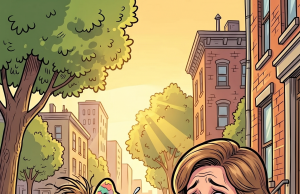
I was standing at the edge of a busy intersection, tracking the mechanical countdown of the pedestrian signal, when a dark sedan accelerated through a massive column of surface water that had accumulated along the concrete curb. The physical execution of the movement occurred with such rapid velocity that I lacked the necessary seconds to adjust my footing or step back into the shelter of the awning.
A heavy, unfiltered wave of muddy water struck my frame with full force, instantly saturating the light fabric of my tailored dress, splashing across the leather of my document bag, and leaving a cold, gritty residue across my left cheekbone. For a handful of seconds, I remained absolutely stationary on the pavement, my breath caught behind my ribs as the dampness began to navigate through the layers of my clothing to settle against my skin.
The vehicle slowed its momentum thirty feet past the crosswalk, the tinted glass of the driver’s side window descending a few inches to reveal the distinct, self-satisfied silhouette of a man who seemed to view the public square as his personal laboratory.
“What exactly is driving your lack of situational awareness?!” I shouted into the wind, my voice sounding thin and fractured against the roar of the passing delivery trucks as I struggled to regain some semblance of authority.
He leaned toward the opening, his features arranged into an effortless, patronizing smirk that suggested my presence on the asphalt was an administrative inconvenience to his morning schedule. “Why are you simply anchoring yourself to the edge of the curb and obstructing the flow of transit?” he snapped, his tone carrying the easy, unblinking arrogance of a person who had never been required to offer an apology to a stranger. “The timing of the signal is entirely irrelevant to my timeline; I am currently managing a critical appointment!”
Before I could formulate a verbal counter-proposal or record the digits of the registration plate, his heel engaged the accelerator with a sudden, violent precision. The heavy rubber tires cut through the remainder of the puddle, generating a secondary, localized spray of gray silt that finished the destruction of my uniform before the vehicle disappeared into the downtown mist.
I stood anchored to the concrete, the cold fabric of my dress clinging to my skin with a heavy friction while my palms began a fine, persistent tremor born of pure, unadulterated frustration. A few passing commuters offered a fleeting glance of mild, detached sympathy before their focus returned to the individual trajectories of their own schedules, leaving me alone with the gray dampness of the avenue.
The Document on the Fourteenth Floor
I reached into the interior compartment of my bag, withdrawing a handful of linen napkins to systematically blot the moisture from my sleeves, though the effort did nothing to alter the structural reality of the stains. A rapid verification of my watch confirmed that the remaining minutes were insufficient to accommodate a transit back to my apartment to execute a change of wardrobe.
I straightened my shoulders, adjusted the strap of my compromised bag, and walked the final two blocks toward the corporate tower, my mind working to compartmentalize the humiliation before I breached the entrance. By the time the glass doors of the lobby slid open, I had already finalized my internal strategy—I refused to grant a random act of street corner incivility the leverage required to derail the most significant evaluation of my financial quarter.
Within a twelve-minute window, I was scheduled to chair a final executive interview panel for a director-level operations position, a role carrying an annual compensation package of 240,000 dollars.
“Good morning, Rosalind,” the security coordinator noted from behind the reception desk, his hands pausing over the visitor logs as his gaze registered the state of my outerwear. “Rough navigation on the avenues today?”
“The local transit was unusually aggressive this morning, Silas,” I replied, keeping my modulation smooth and professional as I accelerated toward the bank of elevators.
By the time the doors parted on the fourteenth floor, the physical evidence of the encounter remained written across my clothes, but the internal architecture of my identity was entirely composed. The primary conference room had already been prepared by the administrative staff when I walked in; two crystal glasses of water were positioned precisely beside the leather-bound notepads, and the human resources department had deposited the candidate’s credential file directly in front of my chair.
I closed the oak panel behind me to exclude the ambient noise of the hallway, set my bag onto the credenza with a slow care, and took my place at the head of the table. I flipped open the textured cardboard of the dossier to review the identity of the individual waiting in the reception lounge—and my fingers froze against the edge of the paper.
The face captured in the high-resolution profile print, arranged into the exact, self-satisfied expression that had looked out from the car window ten minutes prior, belonged to the individual currently registered for the ten o’clock session.
Garrett Vance.
A short, ironic laugh escaped my throat into the quiet room as I tapped the heavy silver casing of my pen against the document. “You have got to be kidding me,” I whispered to the empty chairs.
The Vocabulary of the Boardroom
On paper, Garrett’s historical data was an immaculate blueprint of corporate success, detailing a decade of senior leadership metrics within the logistics sector, a record of consistent infrastructure management, and references from top-tier institutional directors. He was, from a purely analytical standpoint, the precise type of functional asset our firm required to stabilize the regional branch.
I maintained a perfectly flat, unreadable facial geometry as the internal line chimed, and Silas’s voice came through the speaker. “Your ten o’clock evaluation is stationed in the lobby, Ms. Vance. Are you prepared to receive him?”
“Instruct him to enter the boardroom, Silas,” I said calmly.
Garrett walked into the space with the expansive, unhurried posture of a man who assumed that every room he entered was a property he already owned—relaxed, precise, his dark wool suit completely dry from the elements. Then, his gaze reached the head of the table, and his focus locked onto the stains still darkening the fabric of my collarbone.
The transformation of his features was microscopic but instantaneous; a sudden, brief flicker of recognition crossed his eyes, and his leather loafers paused against the carpet for a single, uncoordinated pulse of time.
“Good morning. My name is Rosalind. Please take a seat and provide the panel with a preliminary summary of your operational philosophy,” I said, offering a professional smile that carried no indication of historical context, treating him with the clinical distance one might afford a stranger.
For a handful of seconds, his body remained completely stationary at the edge of the table before his professional conditioning took over, allowing him to smooth his features back into neutrality as he slid into the leather chair opposite mine.
I will grant him this specific validation—the man was exceptionally skilled at the mechanics of self-presentation. His articulation of his past management structures was clear, measured, and direct, demonstrating an undeniable comprehension of corporate logistics as he anticipated the standard technical inquiries before I could even voice them, supporting every metric with concrete examples from his previous quarters.
If our initial intersection had not occurred in the dirt of the crosswalk ten minutes earlier, I would have signed the authorization form without a single second of hesitation.
I entered a few systemic notes onto the margins of the notepad, ensuring the tilt of my wrist prevented him from decoding the orientation of my handwriting. Approximately thirty minutes into the evaluation, a sudden silence fell over the room, the steady hum of the building’s climate control filling the space between us.
Garrett leaned back slightly against the leather cushions, let out a slow, calculated breath, and looked directly into my eyes. “Before we proceed to the secondary criteria, Ms. Vance… I want to offer an authentic apology for the nature of my behavior on the street this morning. I am entirely unable to account for the lack of judgment that governed my actions during that transition.”
There was the pivot point.
I held his gaze for a long, heavy interval, allowing the silence to stretch until the room felt narrow, before I slid the cardboard dossier across the polished walnut table toward his hands. “The apology is noted, Mr. Vance. In fact, your data is superior, and you have secured the position.”
A visible wave of relief and satisfaction tracking across his features, his chin lifting with a hint of that familiar, deep-seated pride.
“However,” I continued, keeping my voice level and measured, “I have appended a series of mandatory operational riders to the terminal contract as a direct consequence of this morning’s indicators. I believe you will find the parameters to be highly educational.”
The Price of Accountability
The transformation of his demeanor was immediate, his smile faltering as he reached out to pull the folder closer, his fingers turning the first page to reveal the addendum I had drafted. The moment his eyes registered the handwritten clauses, his shoulders stiffened into a rigid, defensive alignment.
The conditions I had introduced held no emotional or personal currency; they were constructed with a strict, professional functionality that left no room for legal debate.
The text indicated that the activation of his salary structure was entirely contingent upon the successful completion of a three-week probationary cycle conducted under direct, daily supervision. With me. Furthermore, I had included a stipulation requiring him to personally direct a public-facing community infrastructure initiative, representing our firm’s ethics in real-world environments rather than the insulated sanctuary of the executive offices. And at the base of the white paper, a final clause stood out in bold, unyielding characters: Any display of unvetted or aggressive judgment outside the professional workspace will result in the immediate cancellation of this agreement.
He read the lines twice, his eyes tracking the print before he lifted his face to meet my focus.
Garrett was neither defensive nor visibly angry; his expression held a profound, quiet confusion as if he were trying to identify the underlying strategy of a maneuver he hadn’t anticipated. He had clearly entered the fourteenth floor expecting some form of emotional retaliation—a reactive, personal rejection that he could easily catalog as a corporate grievance.
Instead, the asset he was being offered was far more difficult to manage. It was absolute accountability.
“You indicated a moment ago that you were unable to account for the impulse that governed your behavior at the crosswalk,” I told him, closing my pen with a clean, definitive click. “I have a desire to discover whether that statement represents a permanent condition or a temporary failure of logic.”
The parameters of our dynamic altered completely in that space. Instead of utilizing my authority to exclude him from the firm, I had chosen to test the actual density of his character.
He sat in the silence for a long beat, his palms resting flat against the cardboard of the folder as if he were actively debating whether the compensation package was worth the surrender of his autonomy. Then, he closed the binder.
“Three weeks?” he asked, his voice returning to a steady, conversational register.
“That is the exact dimension of the window,” I replied.
“And the daily supervision will be executed by your office directly?”
“Yes.”
He let out a short, dry breath through his nose, offering a solitary, firm nod of compliance. “Very well. I will accept the terms of the rider.”
The Inventory of the First Week
Garrett’s initial deployment began on the subsequent Monday at precisely eight o’clock in the morning. My digital log recorded his arrival at seven-fifty-two.
I noted the detail without offering a verbal comment, entering the time stamp into my personal ledger as I handed him the schedule I had compiled during the weekend. It was not a sequence of tasks engineered to showcase his executive talents or flatter his administrative pride; it was a grueling, ground-level itinerary designed to expose the actual boundaries of his patience.
Long-distance client communications that required an immense amount of repetitive clarification. Internal alignment sessions where corporate titles carried no structural leverage. Operational check-ins with the junior analytical staff—individuals who were entirely indifferent to a confident carriage or an expensive suit.
Garrett scanned the text on the page, his brow furrowing slightly. “This curriculum appears to favor an extraordinary amount of front-line, public-facing labor, Ms. Vance.”
“That is the explicit intent of the configuration,” I stated, not looking up from my monitor.
He offered another slow, measured nod, his resistance remaining entirely subterranean for the duration of the initial cycle. There was no overt pushback during those first forty-eight hours.
The early data confirmed precisely what I had anticipated from his dossier: Garrett Vance was remarkably polished, technically flawless, and possessed the natural linguistic agility of a born leader. But there were microscopic fissures in the veneer. He had a habit of questioning established operational procedures, always wrapping his inquiries in just enough professional deference to make them sound like objective optimizations.
“Are we entirely confident that this particular workflow represents the most efficient use of the department’s resources?” he would inquire during the morning huddle. “Wouldn’t the data density improve if we restructured the formatting to—”
His analytical logic was technically correct most of the time. But his technical competence wasn’t the metric I was actively tracking from the head of the table. I was watching to see how his system reacted when his choices were denied by the structure of the firm.
Initially, his adaptation was seamless. A symmetrical smile, a quick adjustment of his notes, and a quiet transition to the next line item on the ledger. But beneath that managed serenity, I could detect the high-frequency vibration of his high-idling engine—the slight, rigid tightening of his jaw and the hyper-focused tapping of his fingers against his portfolio whenever his timeline was compromised.
By the conclusion of the first week, Garrett shifted his personal strategy, attempting to introduce a element of charm into our operational meetings. It manifested in the subtle lengthening of casual conversations, light, self-deprecating remarks during the technical transitions, and an effortless, unforced confidence that seemed designed to blur the boundaries of the rider.
“You possess an exceptionally distinct management philosophy, Rosalind,” he remarked one Friday afternoon, his tall frame leaning casually against the stained-wood doorframe of my office.
“Is that evaluation intended as a validation of my metrics?” I asked, keeping my focus locked onto the spreadsheet on my screen.
“I am still compiling the data,” he murmured, his tone carrying a light, conversational rhythm.
I lifted my face, my eyes meeting his for a single, unhurried second. “And yet, despite the lack of clarity, your leather shoes are still crossing my threshold every morning.”
The small smile faltered at the corners of his mouth. He pushed his weight off the casing, offered a brief, quiet tilt of his head, and vanished back down the hallway toward his desk.
The Test of the Delayed Light
The secondary week was the coordinate where I introduced a specific variable designed to test his tolerance for unmanaged friction. I scheduled a high-profile consultation with an institutional client—an event that carried significant weight for his division but was not structurally critical to our quarterly bottom line.
Then, utilizing my authority over the calendar, I engineered a series of deliberate administrative delays.
First, a ten-minute postponement with no explanation routed to his device. Then, twenty minutes. Then, thirty. No updates were entered into the firm’s system, and no personal communications were issued from my assistant to account for the vacuum.
I observed his physical reactions through the glass partition of the library alcove.
He verified the interface of his watch once, then twice, his thumb moving with a rhythmic friction against the leather strap. He rose from his chair, paced the length of the narrow carpeted corridor a single time, and then returned to his seat, his shoulders square and his hands flat against his knees. At the thirty-five-minute mark, the client finally materialized in the reception lobby, visibly flustered and offering a rapid series of apologies for her transit complications.
“I am profoundly sorry for this egregious delay, Mr. Vance,” she said as she hurried into the room. “The highway congestion was completely unmanageable.”
Garrett rose from his chair instantly, his posture open and entirely free of the tension I had recorded through the glass. “There is absolutely no deficit, ma’am,” he replied, his voice maintaining a calm, reassuring resonance that instantly restored order to the room. “The schedule has plenty of elasticity built into it today; let’s begin with the preliminary logs.”
The latent irritation vanished from the space, and the negotiation proceeded with a flawless efficiency. Later that afternoon, I summoned him to my office to review the project summaries.
“Your management of that transition was executed with an exceptional amount of poise, Garrett,” I noted, closing the file.
He gave a light, noncommittal shrug of his shoulders. “I failed to see another logical option that preserved the client’s confidence.”
That wasn’t entirely factual. There are always alternative options available to a man with his level of leverage. But on this particular afternoon, he had actively selected the calmer frequency—a complete departure from the individual who had leaned out of the dark sedan at the crosswalk.
A few days later, a secondary data point manifested within his division. One of our junior researchers, a young woman named Maya, had committed a formatting error in a regional resource report. It wasn’t a structural disaster, but it possessed enough variance to cause a significant complication if the data had cleared the building and reached the client’s auditing team.
I recorded the discrepancy before the hard copy was stamped for courier delivery. So did Garrett.
I watched through the open door as he navigated the space between the cubicles and approached Maya’s desk. The young woman looked up from her monitor, her shoulders instantly squaring into that rigid, defensive posture that children of the corporate hierarchy adopt when they are bracing themselves for an executive correction. I recognized that look; it was the exact geometry of my own stance on the street corner three weeks ago.
But when Garrett reached the edge of her workspace, he paused, his chest expanding as he drew a slow, deliberate breath of the office air. He didn’t offer a sharp, public display of frustration, and his voice carried no cutting edge of superiority.
“Hey, Maya, do you have fifteen minutes to walk through the metrics of this resource log with me?” he asked gently. “I think a few of the formulas require a bit of manual alignment before we authorize the final print.”
There was no trace of administrative leverage, no hint of a threat to her standing. They spent the next quarter of an hour reviewing the columns line by line, his finger tracking the calculations on her screen with a quiet patience. When he finally walked away from her desk, the tension had entirely left her features, replaced by a visible, quiet relief.
That specific interaction remained with me throughout the evening, altering the way I viewed the remainder of his probation.
The Choice of the Circuit
By the middle of the terminal week, I began to notice a sequence of smaller, more substantial alterations in his behavioral patterns. He paused for a longer beat before responding to direct challenges during the staff meetings; he listened to the technical arguments of the junior analysts with a focused, unblinking attention, and there were distinct moments when I could physically see an aggressive reaction forming behind his eyes—only to be consciously checked and dismantled before it could alter his voice. That wasn’t a performance engineered to secure a contract; that was the hard, deliberate labor of a man rewiring his own machinery.
Halfway through that final week, an official email from the human resources director landed in my inbox. Tucked beneath the routine paperwork required to formalize Garrett’s transition into his permanent salary structure was a secondary notification from our recruitment monitoring system.
Another logistics firm downtown had issued him an independent offer. A higher base salary. An immediate start date. No probationary addendums attached to the signature line.
I leaned back against the cushions of my chair, staring at the text on the screen for several long minutes. He had mentioned absolutely nothing about the competitive offer during our morning briefing.
I closed my laptop, stood up from my desk, and opened the door to the inner office. “Garrett,” I called out into the quiet space. “Do you have a moment to step inside?”
He sat across from my desk once again, assuming the exact position he had occupied during the initial ten o’clock evaluation three weeks prior. But the physical carriage of his body had undergone a profound modification; there was significantly less performative certainty in his shoulders, replaced by a quiet, watchful awareness that seemed to take in the full dimensions of the room.
“The human resources framework flagged a competitive offer from the logistics group downtown,” I said, my voice dropping into a level register. “You chose to omit that data from our morning project review.”
He gave a small, noncommittal movement of his head. “I didn’t consider the notification to be relevant to my current commitments.”
“The financial margin they are projecting appears remarkably relevant from a corporate standpoint,” I countered, watching his face for any indication of a shift.
“Perhaps,” he murmured, his gray eyes locking onto my focus with an absolute, steady calm. “But the reality is that my leather shoes are still crossing your threshold every morning.”
I studied the lines of his face for a long, silent interval. “Why choose to remain within a framework that requires you to validate your character every twenty-four hours, Garrett?”
The question hung in the quiet between our chairs, the corporate masks entirely useless in the face of the inquiry. Then, he answered, his voice dropping into a register that held no trace of the old boardroom performance.
“Because your addendum made me realize that I have no desire to remain the version of the man you encountered at the crosswalk three weeks ago.”
There was no calculation in his features. There was no socialite charm designed to purchase my compliance. There was only the factual, unvarnished truth of a human being who had chosen to look at his own reflection. For the first time since the rain had hit my face, I believed him completely.
The Legacy of the Addendum
The terminal day of his probationary cycle arrived with a clear, unblemished sun that washed the fourteenth floor in a brilliant, gold light. Garrett walked into my office at precisely nine o’clock in the morning, his posture straight and his movements unhurried.
The permanent executive contract sat on the center of the walnut desk, the restrictive conditions of the initial rider having been systematically removed by the human resources department to restore the document to its original format.
“The three-week metric has been successfully achieved, Garrett,” I said, sliding the folder a few inches across the wood toward his position. “The validation is complete. You have the option to execute this signature line and take full custody of the division, or you can walk out the door toward the competitive offer downtown.”
Garrett looked down at the white paper, but his fingers made no movement to open the binder. A few long seconds passed in absolute stillness while the traffic hummed on the avenue below the glass. Then, he lifted his face.
“I intend to stay within this structure,” he stated clearly.
I offered a single, firm nod of agreement, reaching for my pen to finalize the corporate logs. But before I could touch the plastic, he added a final condition of his own.
“But I am only signing this document if the accountability clauses from your original rider remain a permanent part of my contract file.”
The request caught my professional reflexes entirely off guard—not because of the logistical complexity of the text, but because of what the language signified about his trajectory. He was no longer treating the concept of supervision as an institutional punishment to be endured until the calendar cleared; he was actively selecting accountability as the baseline of his career.
I studied his gray eyes for a handful of seconds, searching for the ghost of the man in the dark sedan, but the mirror was completely clean.
“The amendment will remain a permanent fixture of your record, Garrett,” I said, closing the folder and extending my hand across the desk.
Because at that specific junction of our history, the dynamic had ceased to be about the muddy water, the humiliation of the crosswalk, or the survival of my own pride. It had become about the architecture of who Garrett Vance had chosen to become when the lights were bright. And for the first time since that October morning, as his hand closed around mine in a firm, mutual grip, I didn’t see the individual who had accelerated through the rain. I saw a leader who understood that real power isn’t the capacity to command the avenue, but the courage to remain accountable to the people walking on it.